
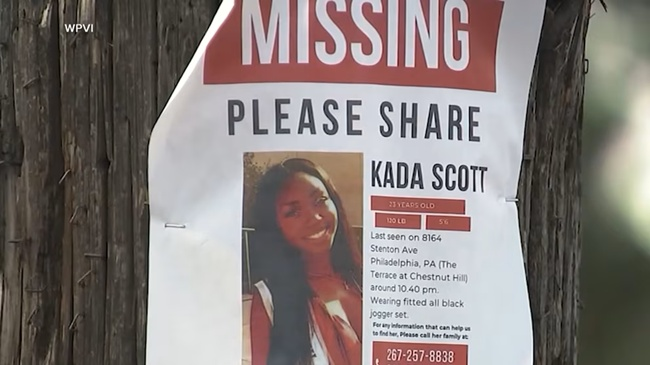
When 23-year-old Kada Scott disappeared from Chestnut Hill earlier this month, her family acted immediately — calling police, organizing searches, and rallying community support online. For two anxious weeks, they pleaded for answers. Then came the news no one wanted to hear: human remains discovered behind an abandoned school in Germantown had been identified as Kada.
Her death has shaken Philadelphia — but for many advocates, it also exposes a painful, recurring truth:
Black women go missing, and too often the system fails to find them in time.
💔 A Familiar Story with Unfamiliar Names
Kada Scott’s case mirrors a troubling national pattern.
While Black women and girls make up less than 15 percent of the U.S. female population, they represent nearly 35 percent of all missing women reported to the FBI’s National Crime Information Center. Yet, studies consistently show that cases involving missing Black women receive significantly less media coverage, slower investigative response, and fewer resources than those of their white counterparts.
Advocates call this disparity the “Missing White Woman Syndrome.”
It’s a phenomenon that prioritizes certain victims — typically young, white, middle-class women — for national attention, while others, like Kada, remain invisible until tragedy forces the spotlight.
“Kada’s story didn’t dominate headlines until her body was found,” said Tanya Jefferson, founder of Sisters Searching for Sisters PHL, a nonprofit focused on missing Black women in Pennsylvania. “By then, it was too late. The first 48 hours are everything — and the response we get in our communities rarely reflects that urgency.”
🚨 Systemic Blind Spots and Bureaucratic Barriers
The failures begin at the reporting stage.
Families often encounter delays when filing missing-person reports, especially for young Black adults. Too frequently, police label cases as “runaways” or “voluntary absences,” even when families insist otherwise.
In Kada’s case, loved ones say they faced slow communication and limited updates in the early days of the investigation. Her burnt vehicle — discovered behind an abandoned school — should have triggered an immediate multi-agency search, but by the time investigators pieced together the clues, critical days had passed.
“Every minute matters,” said Dr. Vanessa Tyler, a criminologist at Temple University specializing in race and justice. “These are not isolated mistakes. They reflect a deeper bias in how urgency is defined and whose safety is prioritized.”
⚖️ The Justice System and a Cycle of Repeat Offenders
The suspect in Kada’s case, 21-year-old Keon King, was already facing serious charges for assault and arson earlier this year — yet was released on bail. That detail has outraged residents and reignited debate about Philadelphia’s bail-reform policies and how dangerous offenders slip through cracks in supervision.
District Attorney Larry Krasner defended the system’s intent — emphasizing fairness and bail as a constitutional right — but conceded that “a tragedy like this demands reflection.”
Critics argue that repeat violent offenders are too often released without sufficient monitoring, leaving women like Kada vulnerable.
🕯️ The Emotional Toll on the Community
The Germantown and Chestnut Hill neighborhoods are united in grief. Candlelight vigils have filled social media with photos of Kada smiling, laughing, and dancing — reminders of the light extinguished too soon.
“Her energy was pure joy,” said Aaliyah Banks, one of her close friends. “Now, every woman I know is walking to her car looking over her shoulder.”
That fear is not unfounded.
According to the Black and Missing Foundation, over 60,000 Black women and girls are currently missing nationwide — and too many families report the same frustration: lack of visibility, lack of urgency, and lack of justice.
🧭 From Tragedy to Action: Building Better Systems
In the wake of Kada’s death, State Representative Napoleon Curry (D-Philadelphia) called for a formal review of how local law enforcement handles missing-person cases involving women of color.
He also urged Pennsylvania to explore a state-level alert system similar to California’s “Ebony Alert,” which issues targeted notifications for missing Black youth and women.
“Our community deserves to know that when one of our daughters disappears, the system will move heaven and earth to bring her home,” Curry said in a recent statement.
“Anything less is unacceptable.”
Philadelphia advocates are echoing that call, demanding:
-
A dedicated missing-persons task force focusing on Black women and girls.
-
Mandatory bias-awareness training for police and media professionals.
-
Expanded mental-health and victim-support services for families.
-
Stronger monitoring of repeat violent offenders and bail reform accountability.
🕊️ Honoring Kada Scott’s Legacy
For Kada’s family, justice will come not only through prosecution but through reform. Her mother shared through a family spokesperson:
“We can’t bring our baby back. But if her story forces change — if it saves one life — then her spirit will live on.”
Community groups are planning a “Justice for Kada” march and vigil in Germantown next week, calling for unity, accountability, and policy change. Organizers hope the event becomes an annual reminder of the many missing Black women whose names we may never know.
📢 A Call to Remember Every Name
Kada Scott’s story is not an isolated tragedy. It’s part of a systemic failure — one that demands national recognition and local change.
When Black women go missing, their families shouldn’t have to fight for attention. Their pain shouldn’t have to compete for headlines. Their lives should matter from the moment they vanish — not just after they’re found.
Until that truth becomes policy, Philadelphia — and America — still have work to do.
Sources: People.com | AP News | 6ABC Philadelphia | PA House Press Release | Black and Missing Foundation | Temple University Department of Criminal Justice